Growth in recorded lodging nights slowed to low single digits over the summer, following a strong first half of 2026, according to new proprietary expense data from Emburse. A fixed cohort of 586 U.S.-headquartered customer organizations, encompassing approximately 25,000 lodging-expense submitting employees, showed lodging nights in the 10 highest-volume U.S. cities rose 16.6% year over year in the first half, before slowing to low single-digit growth by summer. Because recent expense records can arrive after the reporting period, the summer figures should be viewed as an observed pattern rather than a definitive measure of demand.
This press release features multimedia. View the full release here: https://www.businesswire.com/news/home/20261008491299/en/
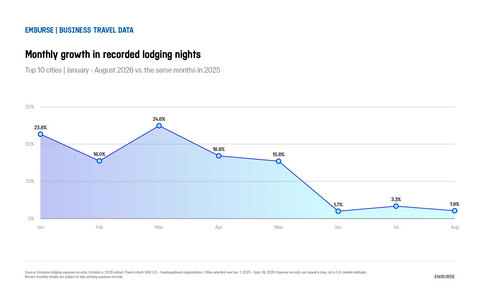
Top 10 U.S. Cities, monthly growth in recorded lodging nights YoY, 2025 vs. 2026
Because the monthly figures compare the same months year over year, the slowdown reflects a change in the rate of growth rather than simply a month-to-month seasonal decline in summer travel. The data does not establish that business travel demand is contracting or predict how 2027 will unfold. It does, however, suggest that companies preparing next year’s budgets should be cautious about simply carrying the strong first-half growth rate forward.
The changing pace of business travel also highlights why price is only one input for travel planning.
Across the Top 10 cities, positive U.S.-dollar lodging expenses increased from approximately $14.50 million in the first half of 2025 to $16.72 million in the first half of 2026, even though average lodging expense for each recorded night fell from about $292 to $289. Companies recorded more business travel lodging nights, pushing total expense higher even as expense per night edged down.
“The 2026 data shows why room price alone cannot give finance teams a complete view of travel spend,” said Michele Shepard, chief revenue officer at Emburse. “Companies recorded more business travel lodging nights, pushing total expense higher even as expense per night went down. Going into 2027, finance and procurement teams should look at where lodging demand is concentrated, how much activity is being recorded across their workforce and whether recent travel levels are holding. That gives them a stronger basis for setting budgets and negotiating with suppliers.”
Travel patterns provide a fuller picture of budget pressure
In the first half of 2026, 12,495 employees submitted lodging expenses in these cities, up 7.5% from 11,625 a year earlier. Across the six-month period, lodging expense records included an average of 4.8 nights per submitting employee, up 8.5% from 4.4 nights a year earlier. Separately, average duration recorded on each lodging expense increased 6.8%, from 2.13 to 2.28 nights.
The number of customer organizations recording lodging expenses in the Top 10 cities was virtually unchanged year over year: 583 in the first half of 2026 versus 582 in the first half of 2025, an increase of one organization, or 0.2%, within the fixed 586-customer cohort. Against that steady organization count, recorded lodging nights rose 16.6%, alongside more employees submitting lodging expenses and more recorded nights per submitting employee. Expense records do not establish whether employees took more trips or stayed longer on each trip.
For finance, procurement and business leaders, these patterns provide additional context for setting budgets and negotiating with suppliers. The volume and concentration of lodging activity across destinations can affect purchasing power and total travel cost, even when expense per recorded night is stable.
City-level patterns reinforce the need to look beyond price
- Las Vegas ranked first with 31,973 recorded lodging nights over the full analysis period and 27.2% growth in the first half of 2026. Its activity was broadly distributed across the Emburse cohort, with the largest customer accounting for only 7% of recorded nights, making it one of the dataset’s less concentrated city signals.
- New York recorded 15.6% first-half growth and had the highest full-period average lodging expense among the Top 10 cities, at $461.36 per recorded night. The combination illustrates how increased lodging volume can amplify budget pressure even when expense per recorded night is not accelerating.
- San Francisco posted the highest first-half recorded-night growth among the selected cities at 32.3%, while lodging expense per recorded night declined. The finding should be interpreted with caution, however, because longer recorded durations contributed materially to the result. San Francisco ranks 10th under the report’s 365-night duration cap but falls to 12th when recorded durations are capped at 30 nights.
As organizations prepare 2027 travel budgets, the data points to the value of evaluating recent lodging volume and destination concentration alongside unit costs. Companies can use those patterns, alongside other internal travel data, to test budget scenarios and identify where concentrated purchasing activity may strengthen supplier negotiations. Better visibility, configurable controls and timely policy guidance can then help keep travel programs responsive to changing travel patterns and business needs.
Methodology
Analysis covers a fixed cohort of 586 U.S.-headquartered Emburse customers, using reported U.S. cities and check-ins Jan. 1, 2025–Sept. 18, 2026. H1 compares January–June 2026 with 2025. Cities rank by recorded nights (check-out minus check-in, 1–365), requiring at least two organizations and no customer above 80% of city nights.
Findings are not representative of the U.S. market. Records may repeat stays; unique bookings, trips and hotel occupants are unverified. Expense per recorded night is positive USD lodging expense divided by nights on those same records, not a hotel rate. Recent results may change with late-arriving records; completeness is uncertified.
About Emburse
Trusted globally by more than 12 million finance leaders, travel managers, and professionals, Emburse helps organizations control spend across complex finance operations, serving over 20,000 organizations in 200 countries and territories—including Global 2000 enterprises, SMBs, public sector agencies, and nonprofits.
By proactively managing and accurately validating spend, Emburse ensures robust financial governance, enhanced compliance, and unsurpassed visibility into spend behaviors—all while dramatically streamlining the process for every employee.
Emburse’s Expense Intelligence approach transforms reactive expense management into infrastructure for strategic growth. Powered by Emburse AI, it orchestrates corporate spend across travel booking, reimbursements, AP, and payments, embedding dynamic policy controls and predictive insights directly into workflows. This real-time approach empowers organizations to adapt quickly, reduce risk, and guide spend before money leaves the business.
View source version on businesswire.com: https://www.businesswire.com/news/home/20261008491299/en/
Media gallery