
Key Takeaways
- Between-session homework extends the impact of coaching beyond the hour, reinforcing insights before they fade.
- Clients who actively engage in assigned work between sessions report higher satisfaction and achieve measurably better outcomes.
- Effective homework is not one-size-fits-all – personalisation is what makes assignments stick and motivation last.
- The right tools (journalling prompts, card decks, worksheets) can make between-session work feel less like a chore and more like a habit.
- Read on to discover how homework builds clients who eventually coach themselves – and why that’s the ultimate goal.
There’s a pattern nearly every experienced coach recognises: clients who show up having done the work between sessions consistently make faster, deeper progress than those who don’t. That gap isn’t accidental. It points to something fundamental about how humans learn, change, and sustain momentum – and it’s why between-session homework has become a cornerstone of effective coaching practice.
Clients Who Do the Work Get Better Results
The evidence is consistent. Research on coaching effectiveness suggests that clients who actively engage in between-session work report higher satisfaction with their coaching experience and achieve better outcomes overall. The International Coaching Federation (ICF) identifies client action and accountability between sessions as a core competency for effective coaching – not an optional add-on.
The reason is straightforward: a single coaching session, no matter how powerful, is still just one hour. What happens in the other 167 hours of the week determines whether insights translate into real change. Between-session assignments are the bridge that carries coaching impact into daily life.
What Counts as Coaching Homework?
Coaching homework is broader than most people assume. It doesn’t have to mean filling out a lengthy worksheet or writing pages in a journal. The goal is structured reflection and purposeful action – any format that helps a client stay in a growth mindset between appointments.
Tools, Worksheets, and Card Decks
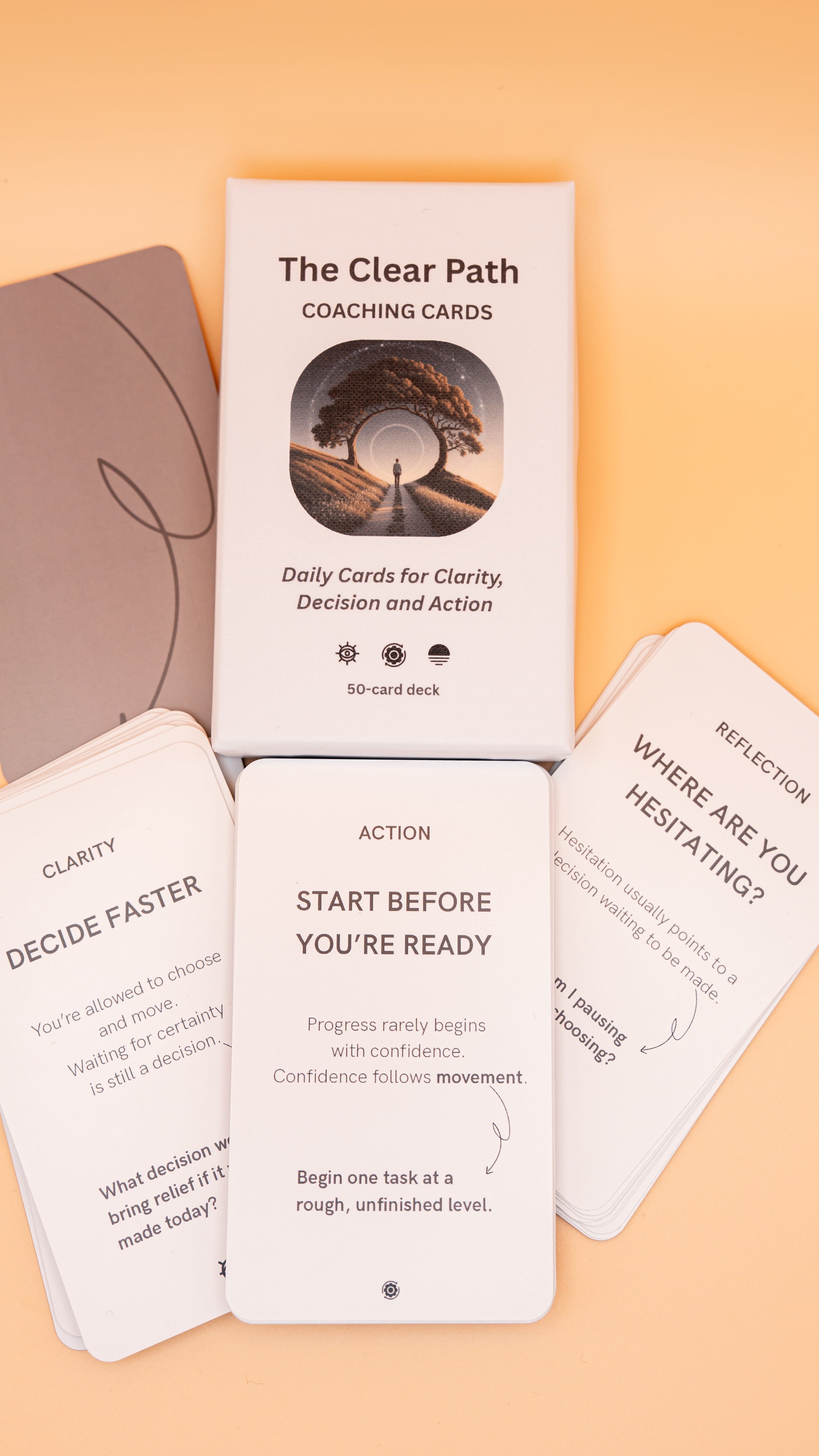
Physical and digital tools give clients something tangible to engage with. Worksheets built around specific topics – values clarification, habit tracking, goal prioritisation – help clients apply session insights in a concrete, structured way. Card decks are particularly effective for daily micro-reflection: a client can draw a single card each morning and sit with one focused question rather than facing a blank page. Resources like the 10 tools that help leaders think more clearly from The Clear Path Cards offer practical examples of how structured prompts support clearer thinking between sessions.
Journalling Prompts and Reflection Exercises
Journalling prompts and enquiry-based exercises are especially well-suited to self-discovery work. Rather than open-ended free-writing, a targeted prompt – such as “Where did I act from fear instead of intention this week?” – directs attention productively. Structured exercises like these deepen self-awareness and foster sustained behavioural change in ways that conversation alone often can’t.
Why Engagement Drops Without Between-Session Work
Without something to do between sessions, clients tend to drift. The clarity and motivation felt at the end of a coaching call can dissolve within 48 hours as daily pressures take over. This insight fade is one of the most common reasons coaching stalls – not because the coaching itself was poor, but because nothing was in place to maintain momentum.
Assignments solve this by keeping clients in a coaching mindset. Even a five-minute daily check-in with a journalling prompt or a weekly worksheet signals to the brain that growth is an ongoing process, not just something that happens once a month on a scheduled call. The result is a client who arrives at the next session with new observations, questions, and progress – rather than starting from scratch.
How Homework Accelerates Client Growth
Reinforcing Insights Before They Fade
Coaching conversations often produce genuine breakthroughs – a new perspective on a limiting belief, a clearer sense of values, a decision that’s been avoided for months. Without reinforcement, those insights can feel abstract by the following week. Between-session assignments create repetition and application, which is how insights become habits. Structured tasks give clients tangible steps to apply what they discovered during the session, building a real sense of progress and achievement between appointments.
Breaking Big Goals Into Manageable Steps
One of the most common reasons clients stall isn’t lack of motivation – it’s overwhelm. When a goal feels enormous, inaction feels safe. Effective homework breaks large objectives into specific, achievable micro-tasks. A client working toward a leadership transition, for example, might be assigned to have one authentic conversation with a direct report before the next session. That’s not a small thing – but it’s doable. Completing it builds the confidence to take the next step. Case study data from executive coaching contexts has shown that leaders who engaged in between-session tasks and practical application activities measurably improved their leadership skills.
The Accountability and Motivation Edge
Why “Did You Do Your Homework?” Isn’t Enough
Accountability in coaching goes deeper than a checkbox at the start of each session. Simply asking whether a client completed their homework puts the focus on compliance – and compliance isn’t the same as growth. More useful questions ask what the client noticed, what surprised them, or what resistance came up. That’s where the real coaching material lives.
Intrinsic Motivation vs. External Pressure
Homework assigned purely to create external accountability can backfire. If a client is doing the work to avoid disappointing their coach, that’s a fragile foundation. The most effective between-session tasks are ones the client genuinely connects to their own goals – where the motivation is internal. This means taking time during sessions to collaboratively design assignments, rather than prescribing them, so clients feel real ownership over the process.
Uncovering Emotional and Environmental Blockers
When a client consistently doesn’t complete their homework, that’s not a failure – it’s data. Resistance to between-session work often points to emotional blockers (fear, shame, perfectionism) or environmental barriers (time, support, conflicting priorities) that the coaching conversation hasn’t yet surfaced. Rather than treating incomplete homework as a problem, skilled coaches treat it as a diagnostic: What got in the way? What does that tell us?
Personalisation Makes Homework Stick
Generic assignments produce generic engagement. A wellness coach working with a burned-out executive needs different homework than a life coach supporting someone through a career pivot. When assignments are tailored to a client’s specific situation, learning style, and current capacity, completion rates improve – and more importantly, the quality of reflection improves.
Personalisation also signals respect. A client who receives an assignment clearly built for them – not pulled from a template – feels seen. That feeling strengthens the coaching relationship and deepens the client’s investment in the process. Research in coaching practice confirms that this kind of tailoring makes the experience more relevant, which in turn drives engagement.
Homework Builds Clients Who Coach Themselves
The deeper purpose of between-session work is to build capacity. Regular engagement with structured reflection helps clients internalise new perspectives over time. They start catching their own patterns, questioning their own assumptions, and problem-solving with the same frameworks introduced in sessions.
This gradual development of self-coaching ability is, in many ways, the highest outcome of a coaching engagement. A client who can self-observe, reflect, and course-correct independently no longer needs to rely on external support to sustain growth. Between-session homework is the practice that builds that skill – session by session, assignment by assignment.
Between-Session Tools Are Your Coaching Superpower
The most effective coaches aren’t just skilled conversationalists – they’re architects of client experiences that extend well beyond the session itself. Between-session homework, when thoughtfully designed and meaningfully reviewed, does what no single conversation can: it embeds coaching into the rhythm of a client’s real life.
Whether it’s a targeted journalling prompt, a physical card deck used for daily reflection, or a structured worksheet that maps this week’s actions to a larger goal, the right tool at the right moment can shift a client’s entire trajectory. The key is intentionality – choosing assignments that match the client’s current challenge, stretch their thinking just enough, and reconnect them to their own motivation.
Coaches who build robust between-session practices don’t just get better client results – they build stronger coaching relationships, higher retention, and a reputation for delivering real, lasting change.
See what The Clear Path Cards offers at theclearpathcards.com – purposeful tools designed to help coaches and leaders think more clearly and reflect more meaningfully between sessions.
The clear path cards
3 Monahan Avenue
Purley
England
CR8 3BB
United Kingdom


